
Most executive coaching fails quietly.
Not because the coach lacks empathy. Not because the executive lacks intelligence. And not because the organization failed to invest in development.
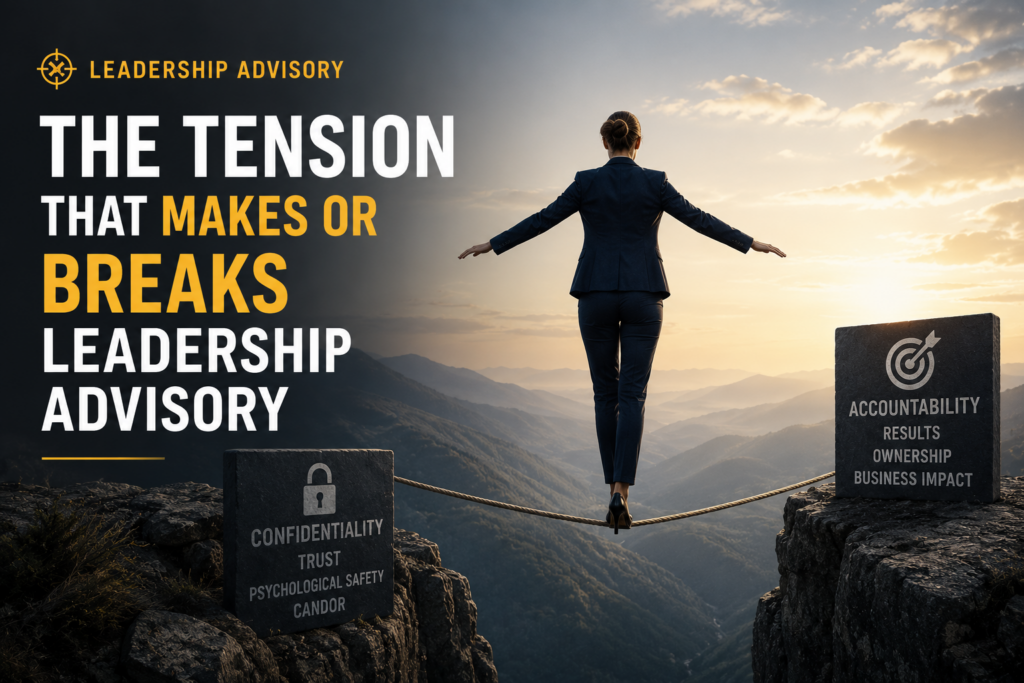
It fails because the coaching system itself becomes structurally misaligned.
Specifically, it over-optimizes for one of two competing forces:
Either psychological safety without accountability…
Or accountability without psychological safety.
One becomes therapy disconnected from business performance.The other becomes performance management disguised as coaching. Neither produces meaningful leadership transformation. The best leadership advisory work operates in the tension between the two and managing that tension deliberately is what separates enterprise-relevant advisory from developmental theater.
The Problem with Pure Confidentiality
Most executives will tell you they value confidentiality in coaching.
They are right to.
Senior leadership roles are psychologically isolating. Executives carry pressures they often cannot process publicly such as board tension, fear of failure, self-doubt, team frustration, investor pressure, political fatigue, or uncertainty around their own capability.
If leaders believe those conversations will become organizational currency, they stop telling the truth.
And the moment candor disappears; coaching loses its value.
Executives need protected space to process their derailers, their insecurities, their emotional reactions, their blind spots, and the internal narratives driving behavior under pressure. Real development often requires discussing material leaders would never disclose in broader organizational settings.
But confidentiality alone creates another problem.
When coaching becomes fully private and detached from business outcomes, it often drifts into introspection without consequence. The executive may gain insight. They may feel supported. They may even become more self-aware. But the business experiences little measurable change.
The leadership team still feels the same friction. Decision velocity remains slow. Accountability remains inconsistent. Stakeholders still experience the same leadership patterns. The coaching becomes psychologically useful, but commercially irrelevant.
The Problem with Excessive Accountability
Organizations sometimes respond to this problem by swinging to the opposite extreme.
They demand measurable coaching outcomes in various forms like progress updates, visible deliverables, behavioral scorecards, and manager visibility into coaching discussions. On paper, this sounds reasonable, logical. After all, leadership development should improve performance!
But when accountability becomes intrusive, executives immediately begin to filter themselves.
Coaching conversations shift from:“What is actually happening?”to:“What is safe to say?”
That distinction matters enormously.
The moment executives feel observed rather than supported, the advisory relationship changes psychologically. Vulnerability contracts. Defensiveness increases. Image management replaces reflection. Leaders begin to perform in coaching rather than truly engage with it.
The irony is that excessive accountability often destroys the very conditions required for meaningful accountability to emerge because sustainable behavioral change rarely begins with external pressure alone. It begins with enough internal honesty to confront difficult truths, which only surface inside trusted environments.
The False Choice
Most organizations unknowingly assume they must choose between protecting the executive or protecting the business. That is the wrong framing. Effective leadership advisory requires both.
Executives need confidentiality around the content of coaching conversations, but organizations also deserve visibility into the commitments, priorities, and behavioral shifts tied to business performance.
The content remains confidential.The commitments become visible.
This is where many advisory models break down. The objective is not to expose private conversations to managers or boards, but rather to align development to enterprise reality.
That means clarifying the business context, identifying the leadership behaviors most affecting execution, aligning on development priorities, and evaluating progress through observable behavior change.
Not emotional disclosure, or personal storytelling, or forced transparency. Observable leadership behavior.
The executive does not owe the organization access to their inner processing. But they do owe the organization meaningful adaptation when behavior is constraining performance.
How We Operationalize This at Lodestone
At Lodestone, leadership advisory begins with alignment, not abstraction.
At the outset of an engagement, we establish a formal advisory game plan that clarifies, the business context, the enterprise priorities, the executive behaviors most affecting execution, the developmental focus areas, and the measurable indicators of leadership impact.
This baseline is informed through objective data collection, including personality assessment, simulation data, stakeholder feedback, and often 360 interviews designed to surface leadership patterns, blind spots, strengths, and potential derailers.
The resulting advisory plan is then aligned with the appropriate stakeholders, often board members, investors, or executive managers, particularly when advising CEOs or enterprise-critical leaders.
This alignment creates shared clarity around what success looks like without compromising the confidentiality of the coaching relationship itself.
The coaching conversations remain private, but the agreed-upon focus areas, leadership commitments, and observable behavior shifts remain visible and measurable throughout the engagement. Progress is evaluated in real time against the original baseline and developmental priorities, and at the conclusion of the engagement, improvement is reassessed relative to the original focus areas. This structure allows coaching to remain psychologically safe while also remaining commercially credible.
The executive retains protected space for candor and reflection, and the organization retains confidence that development is producing meaningful behavioral adaptation tied to business performance. Both are necessary.
Why This Matters More Under Pressure
This tension becomes most important precisely when the business environment becomes unstable because pressure amplifies existing leadership patterns.
Under stress, controlling leaders may over-control, conflict-avoidant leaders delay may tend to hard conversations, highly analytical leaders slow decisions, optimistic leaders minimize risk, and relational leaders avoid consequence management.
These patterns are often psychologically rooted and emotionally charged.
Working through them requires confidentiality. But if those patterns materially affect enterprise execution, the work cannot remain disconnected from accountability either.
This is especially true in private equity environments where timelines compress, expectations intensify, and leadership adaptation directly affects enterprise value. At that point, leadership coaching is no longer a personal luxury.
The Real Measure of Leadership Advisory
The real measure of coaching is not whether the executive enjoyed the conversations.
It is whether leadership effectiveness materially improved.
Did decision quality improve?Did clarity increase?Did stakeholder trust strengthen?Did accountability rise?Did the team align faster?Did execution accelerate?Did the executive expand their range under pressure?
Those are enterprise questions and answering them requires both safety and accountability operating together. Too much confidentiality and coaching may lose consequence. Too much accountability and coaching begins to lose truth. The tension is not the problem. The tension is the design requirement.
The organizations that understand this build leaders who can actually adapt under pressure rather than simply talk about growth in theory.
This piece was written by Dr. Martin Factor, Chief Talent Strategist and Principal of Lodestone. An I-O psychologist by training, he works at the intersection of I-O psychology and private equity, helping firms and portfolio companies figure out whether their leadership can actually deliver on the value creation plan. Want to talk leadership strategy with him directly? Visit us here.