


Most of the private equity firms Lodestone works with right now are sharpening their pencils. Q4 closes the books. Q1 launches the next wave of ambition. Budgets get anchored to deal theses, transformation roadmaps, and revenue targets that look great in a model.
Yet one line item still shows up as discretionary, if it shows up at all: Executive Leadership Team alignment.
Here is the uncomfortable truth. You can fund every initiative in the plan, but if your executive team is not aligned, your strategy will leak out of a thousand invisible seams.
Strategy does not fail. Translation does.
Boards approve strategies. Markets reward narratives. But value creation happens in decision rooms, operating reviews, and the invisible assumptions leaders make under pressure.
The translation of vision into reality does not happen through intent alone. It happens through execution practices that create collective focus around what truly matters now, alignment on who owns what and how tradeoffs get made, engagement through the discretionary energy leaders bring, capability across the system and its people, and measurement that tracks progress and surfaces tension.
These are the mechanics of translation. Without them, even the best strategy remains well funded and quietly stalled.
And without trust, the system constricts. Lack of trust inhibits collaboration, slows decision flow, and quietly suffocates collective innovation. Leaders hedge instead of commit. Risk taking becomes political instead of productive. When alignment is weak around vision, decision rights, role ownership, and trust under stress, what you actually have is six versions of the same strategy running in parallel.
It is like having a full orchestra on stage with no conductor. The musicians are talented. The instruments are tuned. But without shared tempo and coordinated entrances, the sound turns chaotic.
Trust is not a soft asset. It is a growth engine. Innovation does not emerge from brainstorming sessions. It emerges from speed of truth, permission to collide, and confidence that missteps will not be weaponized. When trust is present, ideas move faster from friction to form. When trust is absent, innovation slows into posture and protection.
Low trust quietly taxes innovation through slower incubation, late stage rework, fewer bold bets, and a bias toward safe ideas that protect optics instead of upside. High trust compresses the cycle time between insight and execution and converts collaboration from a meeting behavior into an operating behavior. That is trust as ROI.
The Mosaic Reality of Executive Leadership
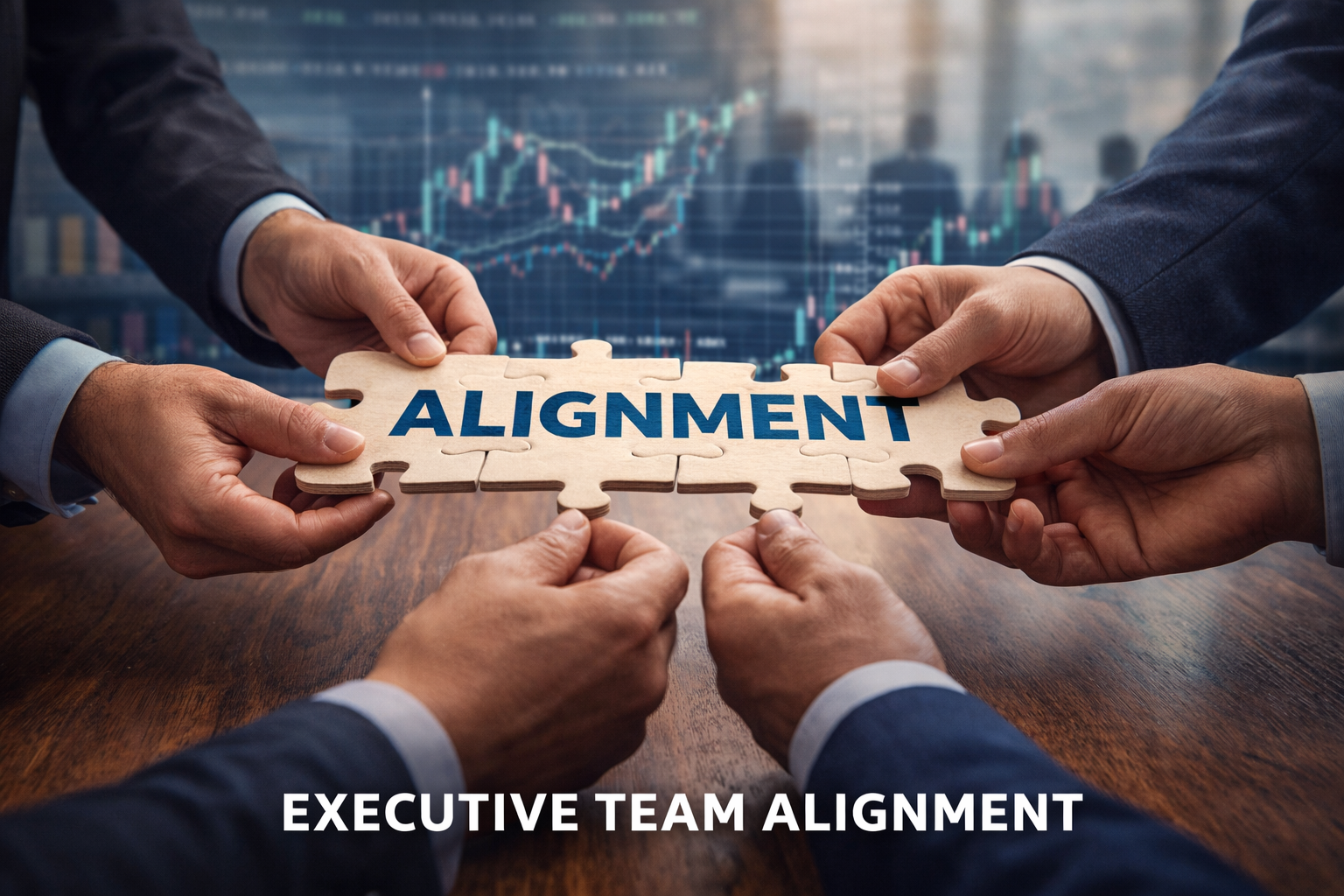
Every executive team is a mosaic of distinct lenses, including growth, operations, ecosystem, and talent. Each leader holds a piece of the picture. But when alignment is missing, executives defend their own tile instead of assembling the image.
The result is not healthy debate. It is fragmentation. And fragmentation is expensive. It shows up as competing priorities, functional whiplash, and slow, political decision making when speed is required.
Alignment does not mean sameness. It means the pieces lock together intentionally to reveal the full enterprise picture.
The CEO Shift From Bottleneck to Conductor
In misaligned systems, the CEO becomes the bottleneck, absorbing tension and mediating every tradeoff. In aligned systems, the CEO becomes the conductor, shaping tempo, coherence, and timing across the enterprise.
That is when organizations move from controlled execution to compounding momentum.
As you finalize 2026 plans, here is the most material leadership question on the table. Is your executive team a true multiplier, or an unpriced risk?
Capital markets do not punish misalignment immediately. They punish it inevitably. And by the time it shows up in the numbers, the cost is no longer just financial.
It is human.