



Most executive coaching does not move the business. It improves awareness. It creates insight. It may even change how a leader feels. But in private equity, none of those are the goal.
Performance is.
Leadership, in this context, is not an abstract capability. It is a lever that either accelerates value creation or quietly constrains it. The problem is not that firms underinvest in leadership. It is that the mechanisms used to improve it are often disconnected from the business itself.
This is where leadership derailment begins.
It rarely shows up all at once. More often, it comes from patterns that once drove success but no longer fit the demands of the role, the team, or the business. A leader continues to operate the way they always have, even as expectations evolve. Over time, those patterns create friction. Execution slows. Teams disengage. Decisions narrow.
Most organizations recognize derailment late, once the cost is already embedded in the business.
Most coaching does not solve for this. It improves insight, but insight alone does not change outcomes. Leaders can spend months working on themselves and still miss what the business actually needs from them. In this environment, that gap becomes costly.
Most coaching approaches over-index on the individual. They focus on personality, preferences, and introspection without sufficient regard for the business context, the evolving demands of the role, or the leadership team. Coaching that is disconnected from these realities risks becoming misaligned rather than a driver of performance.
This is the gap we built our Lodestone Leadership Advisory™ model to close. This is not coaching as reflection. It is coaching as a business-aligned advisory mechanism, and it sits at the core of how we activate tEamBITDA™, the human capital multiplier behind enterprise value creation.
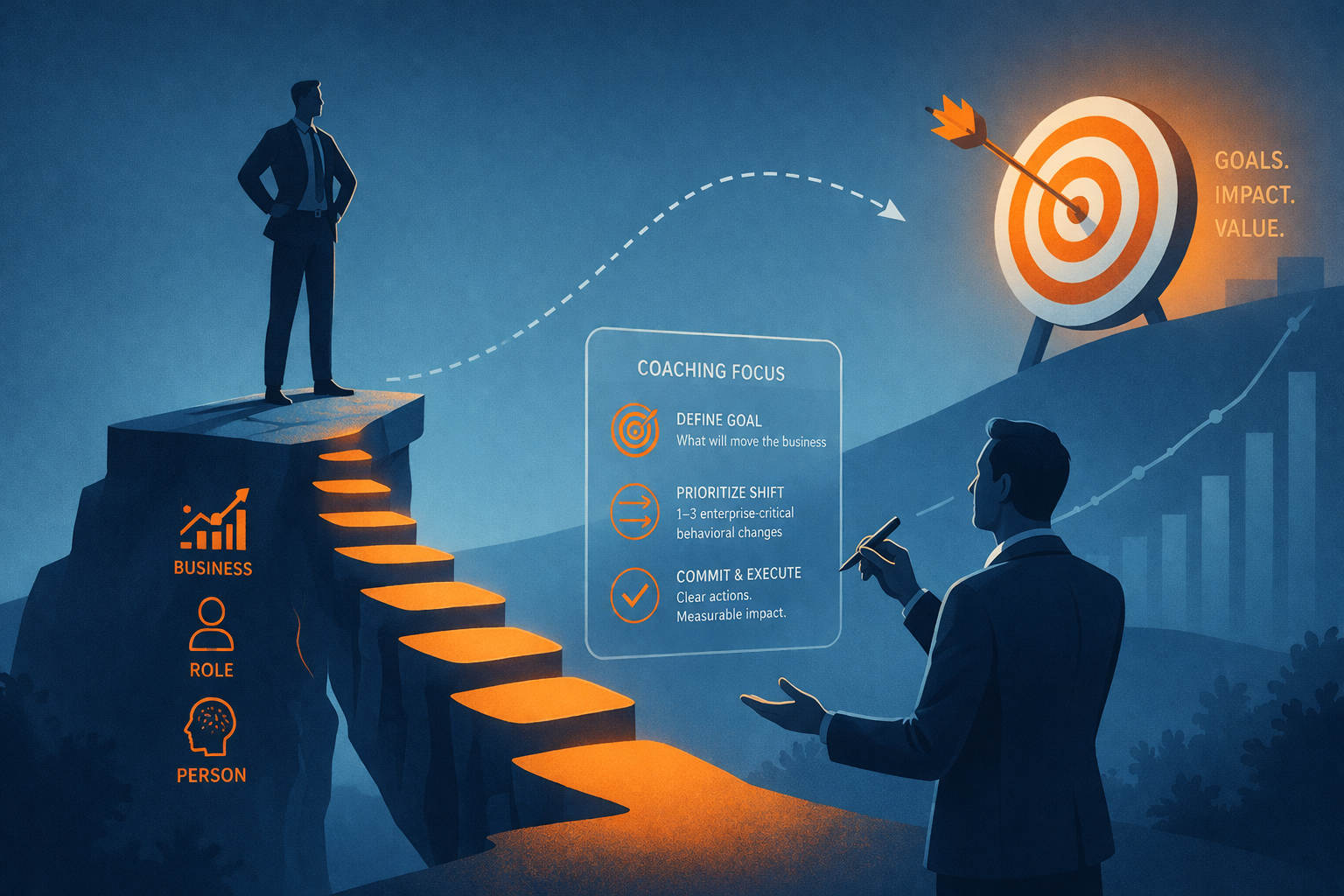
The approach is anchored in the intersection of three forces: the business, the role, and the person.
The business reflects the value creation plan, external pressures, and strategic priorities.
The role reflects what the seat must deliver now as the organization evolves.
The person reflects the leader’s capabilities, patterns, and behavior under pressure.
Derailment risk lives in the gaps between these three.
The work is in continuously reconciling them and identifying the highest-leverage shift a leader can make that will materially impact the business. Coaching without this becomes introspection. Coaching with it becomes a performance lever, one that shows up in execution, decision velocity, and ultimately EBITDA.
At its best, this work is focused. Not a long list of development goals, but one to three enterprise-critical shifts tied directly to business performance and observable behavioral change. Too many priorities dilute focus. Too much reflection delays action.
Development also does not happen in isolation. Every leader operates within a leadership team with its own structure, capability profile, and interdependencies. What a leader should work on is not just a function of individual gaps, but how their role connects to others and where the team as a whole is constrained.
This is where many efforts fall short. Coaching improves the individual but leaves the system unchanged.
At Lodestone, development priorities are shaped by the leadership team mosaic. We examine how capabilities fit together, where there are gaps, and where misalignment is slowing execution. The same leader may need to show up differently depending on the composition and readiness of the team around them. Coaching is not just about improving the individual. It is about improving how the team functions as a system.
Our work is designed to address that directly. Align development to the business. Anchor it in the role. Shape it in the context of the team. And translate it into action.
Every session ends with a clear commitment: what will you be on the hook for when we meet again. Not what you will think about. Not what you will explore. What you will do. Progress is measured through observable change, not intention.
There is also a persistent tension between confidentiality and accountability. Too much confidentiality and the work becomes invisible to the business. Too much transparency and it becomes unsafe for the leader.
We do not view this as a tradeoff. We treat it as a design principle.
The work itself remains confidential. Session discussions, personal reflections, and underlying dynamics stay between the leader and the advisor. That is what enables candor and real work.
What is not confidential are the commitments. Development priorities are explicitly defined, aligned, and visible to key stakeholders. In private equity environments, that often includes investors, board members, and direct managers. Their input helps shape what needs to change based on the business, the role, and the risks to execution.
Those priorities, the expected behavioral shifts, and the measures of impact are shared. Progress is evaluated against observable change, not subjective perception.
The leader has a protected space to do the work. The business has visibility into what is being worked on and whether it is improving. Confidentiality enables trust. Accountability ensures relevance. You need both.
This is not coaching as reflection. It is coaching as an operating mechanism inside the business.
The real test is whether the work holds under pressure. When conditions change, when expectations tighten, when strategy shifts, derailment risk increases. The goal is not personality change. It is situational effectiveness.
In one engagement, a private equity firm placed a first-time CEO into a portfolio company with a clear investment thesis. Within a year, that thesis became partially unworkable due to regulatory shifts and market contraction. The CEO’s mandate shifted from execution to adaptive leadership under constraint. The advisory focused on one to two enterprise-critical shifts aligned to the evolving business context and stakeholder expectations. Decision cycles accelerated. Communication sharpened. Team accountability strengthened. Investor confidence improved. The leader did not become someone else. He became the leader the situation required.
Leadership derailment is not random. It is patterned, and in most cases, it is preventable.
This is the discipline we have built our leadership advisory work around. When development is grounded in the business, the role, and the team, and shaped by the leadership mosaic, those patterns can be identified earlier, addressed directly, and translated into changes that show up in how the business performs.
This is where tEamBITDA is realized.
If you are evaluating how leadership is enabling or constraining your value creation plan, we are happy to share how we approach it. If your portfolio company performance is lagging the plan, it is worth asking whether leadership behavior is part of the constraint. That is where we focus.